
Six years ago, my wife and I were discussing the gospel on Sunday afternoon and the topic of gender came up. We talked about what our thoughts on gender roles are, what strength that can bring to a relationship, and how the roles can be abused. This lead itself to a discussion on some of the most frequent misconceptions about the priesthood we've heard--either inside or outside the LDS church. They boiled down to four categories:
- Men need the priesthood to be as righteous as women
- A women shouldn't want the priesthood and should be glad to have men handle it for her
- Women should have the priesthood in the same way that men do
- Childbearing and nurturing are a "woman's priesthood"
Wanting to understand why, if at all, these are in fact misconceptions as we felt, we decided to explore each of these ideas. The following are some of the results of our conversation. And yes, depending on who you are, our Sunday afternoons are either very mentally stimulating or absolutely boring.
Misconception 1: Men need the priesthood to be as righteous as women
Contrary to some modern ideals, the scriptures teach that either sex is incomplete, imperfect, and will fall short of its highest potential without the other. Rather than a competition or battle between the sexes, a pathway of partnership is described:Nevertheless neither is the man without the woman, neither the woman without the man, in the Lord.
For as the woman is of the man, even so is the man also by the woman; but all things of God.
1 Cor. 11:11–12
In the celestial glory there are three heavens or degrees;
And in order to obtain the highest, a man must enter into this order of the priesthood [meaning the new and everlasting covenant of marriage];
And if he does not, he cannot obtain it.
He may enter into the other, but that is the end of his kingdom; he cannot have an increase.
D&C 131:1–4 (note that [] is in original text)
For behold, I reveal unto you a new and an everlasting covenant; and if ye abide not that covenant, then are ye damned; for no one can reject this covenant and be permitted to enter into my glory.
For all who will have a blessing at my hands shall abide the law which was appointed for that blessing, and the conditions thereof, as were instituted from before the foundation of the world.
And as pertaining to the new and everlasting covenant, it was instituted for the fulness of my glory; and he that receiveth a fulness thereof must and shall abide the law, or he shall be damned, saith the Lord God.
D&C 132:4–6
Speaking on the New and Everlasting Covenant of Marriage, Spencer W. Kimball said:
This is the word of the Lord. It is very, very serious, and there is nobody who should argue with the Lord. He made the earth; he made the people. He knows the conditions. He set the program, and we are not intelligent enough or smart enough to be able to argue him out of these important things. He knows what is right and true.
--Spencer W. Kimball, Marriage and Divorce: An Address [Salt Lake City: Desert Book Co., 1976], 30

The main point here is that either sex will be damned, meaning falling short of their fullest potential, without entering the New and Everlasting Covenant of Marriage with the other. It's important to point out that a man or woman can still be exalted and return to God's presence without entering into the covenant with the other sex. But that what's being said above is that even within that exaltation there's a limitation (a damning) that prevents receipt of the the fullness of God's glory.
Furthermore, the concept that a certain individual is inherently inferior to another goes against fundamental principles of the gospel. There is no room for misogyny or misandry in God's plan.
For by one Spirit are we all baptized into one body, whether we be Jews or Gentiles, whether we be bond or free; and have been all made to drink into one Spirit.
For the body is not one member, but many.
1 Cor. 12:13–14 (note the context of Gifts of the Spirit and unity in Christ)
There is neither Jew nor Greek, there is neither bond nor free, there is neither male nor female: for ye are all one in Christ Jesus.
And if ye be Christ's, then are ye Abraham's seed, and heirs according to the promise.
Gal. 3:28–29 (note allusion to Abrahamic covenant which includes New and Everlasting Covenant)
And have put on the new man, which is renewed in knowledge after the image of him that created him:
Where there is neither Greek nor Jew, circumcision nor uncircumcision, Barbarian, Scythian, bond nor free: but Christ is all, and in all.
Col. 3:10–11
For none of these iniquities come of the Lord; for he doeth that which is good among the children of men; and he doeth nothing save it be plain unto the children of men; and he inviteth them all to come unto him and partake of his goodness; and he denieth none that come unto him, black and white, bond and free, male and female; and he remembereth the heathen; and all are alike unto God, both Jew and Gentile.
2 Ne. 26:33
Misconception 2: A women shouldn't want the priesthood and should be glad to have men handle it for her

As for the exact state between the sexes in the life hereafter, we simply don't have the details. But I take God at His word that 'all' that He has will be given to those who are exhaled. I don't think the word 'all' is merely an exaggeration. This life is a period of training/trails/tests and we only see in part. We only have an incomplete picture here in this life. We are here, in mortality, out of God's presence, in this moment in time, in this dispensation, on this planet, etc. So we have only a shadow of God's will, not the whole picture. We have to trust and have faith that the shadow God reveals is for our benefit and will lead us to a more complete picture in His due time--whatever that might be.
Misconception 3: Women should have the priesthood in the same way that men do
This is the old confusion of 'oneness' = 'sameness'. God designates distinct rights, authority, and responsibilities in order to avoid confusion and to require unity between His children in order for them to enjoy the fullness of His blessings (see 1 Cor. 12). The fact that one person has different rights, authority, or responsibilities does not diminish the rights, authority, or responsibilities of another. Rather, it is only through the unity of faith, hope, and charity that all rights, authorities, and responsibilities are enjoyed by all through one another. It is interesting that charity both fulfills the law in that it ensures one always lives according to God's will while at the same time it is also the virtue through which we are able to enjoy and share the blessings of others and ultimately all that God has. Charity fulfills the law on a personal level but is also the means through which all of God's blessings are both received and bestowed. It is of no surprise then that only through perfect charity between couples in the New and Everlasting Covenant of marriage are they able to enjoy perfectly, and with unity, the blessings each of the other has. The alternative is to see the differences in others as a threat. That one's gifts somehow diminish me. To let pride and fear take root in our world-view.
 |
| Holy Trinity, fresco by Luca Rossetti da Orta |
This same focus on unity as the means of enjoying all of God's blessings is woven into the oath and covenant of the priesthood itself:
For whoso is faithful unto the obtaining these two priesthoods of which I have spoken, and the magnifying their calling, are sanctified by the Spirit unto the renewing of their bodies.
They become the sons of Moses and of Aaron and the seed of Abraham, and the church and kingdom, and the elect of God.
And also all they who receive this priesthood receive me, saith the Lord;
For he that receiveth my servants receiveth me;
And he that receiveth me receiveth my Father;
And he that receiveth my Father receiveth my Father's kingdom; therefore all that my Father hath shall be given unto him.
And this is according to the oath and covenant which belongeth to the priesthood.
Therefore, all those who receive the priesthood, receive this oath and covenant of my Father, which he cannot break, neither can it be moved.
But whoso breaketh this covenant after he hath received it, and altogether turneth therefrom, shall not have forgiveness of sins in this world nor in the world to come.
D&C 84:33–41
In fact, the idea that in order for there to be oneness or perfect unity everyone must be the same is a satanic idea as it presupposes that such unity between different individuals is impossible when the Godhead and the words of the prophets teach otherwise. It also rejects the individuality God has bestowed upon us through agency and has so carefully guarded at great cost. This could have been part of what the war in Heaven was fought over. Christ and His followers fought to maintain individuality and agency with unity coming through the Atonement, priesthood, and chrarity and Satan and his followers fought to remove individuality and agency seeing unity as incompatible with them because of fear, hate, and pride. Knowing this, it brings into perspective why we must share our gifts, talents, and blessings with others in perfect unity of faith and how if we fail to do so, we will never be able to establish the Kingdom of God on Earth.
Misconception 4: Childbearing and nurturing is the "women's priesthood"

Sheri L. Dew, in her wonderful October 2001 General Conference talk "It Is Not Good for Man or Woman to Be Alone", explained it this way:
Satan understands the power of men and women united in righteousness. He is still stinging from his banishment into eternal exile after Michael led the hosts of heaven, comprised of valiant men and women united in the cause of Christ, against him. In the chilling words of Peter, “The devil, as a roaring lion, walketh about, seeking whom he may devour.” Lucifer is determined to devour marriages and families, because their demise threatens the salvation of all involved and the vitality of the Lord’s kingdom itself. Thus, Satan seeks to confuse us about our stewardships and distinctive natures as men and women. He bombards us with bizarre messages about gender, marriage, family, and all male-female relationships. He would have us believe men and women are so alike that our unique gifts are not necessary, or so different we can never hope to understand each other. Neither is true.
We must either learn to live together in unity or all fail together in pride. The New and Everlasting Covenant of Marriage truly is an essential and equally beneficial exalting covenant!
In a recent speech, Sheri L. Dew directly addressed the issue of women not having the priesthood in the LDS church:
From a BYU Women's Conference talk titled "Becoming Bone of Bone and Flesh of Flesh", Eugene England states that our current earthly assignments are mortal schoolmasters and as we progress towards perfect love and charity we will transcend these distinctions:
I believe that the Melchizedek Priesthood and bearing the bodies of mortal children are simply assignments made for mortality. This does not mean the two are equivalent: certainly priesthood should not replace the nurturing duties of fatherhood nor does bearing children replace the spiritual gifts, including healing, nor the administrative gifts and duties given to women. But I believe priesthood and child-bearing are alike in providing, if we let them, similar opportunities to learn charity, to love and serve unconditionally. If we learn those lessons, we will pass beyond Melchizedek Priesthood and physical motherhood to a higher state of more perfect equality. That higher state, promised in the eternal marriage covenant, is called becoming kings and queens, priests and priestesses unto the most high God. Fatherhood and motherhood are equivalent right now in their intrinsic responsibilities. (President Lee said to both men and women that the most important work we will ever do is within the walls of our own home "and President McKay said to us both that no success could compensate for failure there.) The roles of man and woman are absolutely equivalent in their intrinsic joys and opportunities to learn the greatest joy--and the ground of our salvation--which is that pure love of Christ.
The Family: A Proclamation to the World
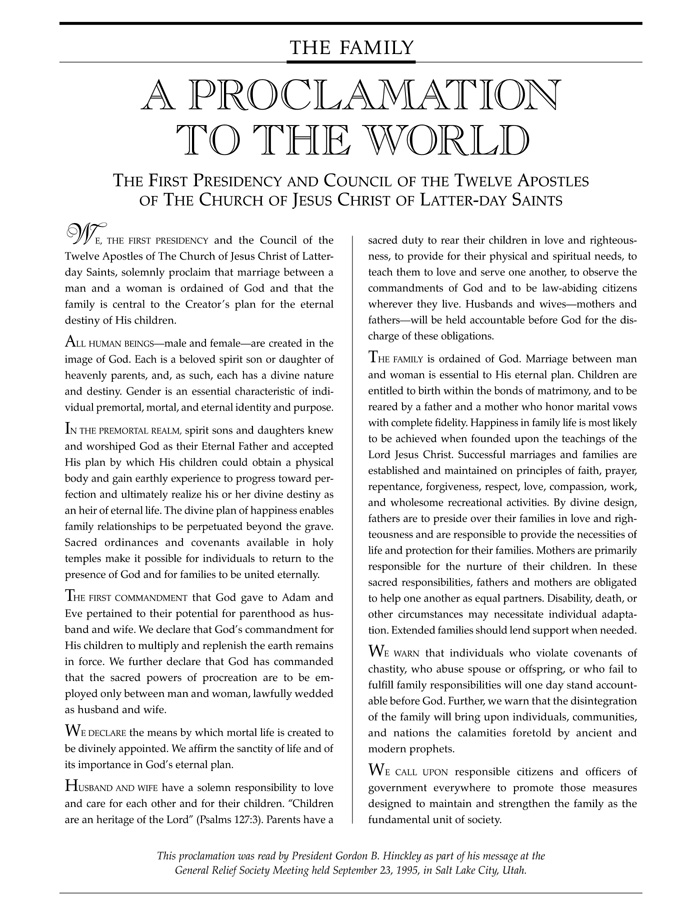 In September 23, 1995 "The Family - A Proclamation to the World" was read by Gordon B. Hinckley in the General Relief Society Meeting. It expounds on the LDS doctrinal view of the roles of men and women in God's plan. In it, it states:
All human beings—male and female—are created in the image of God. Each is a beloved spirit son or daughter of heavenly parents, and, as such, each has a divine nature and destiny. Gender is an essential characteristic of individual premortal, mortal, and eternal identity and purpose.
We believe in being honest, true, chaste, benevolent, virtuous, and in doing good to all men; indeed, we may say that we follow the admonition of Paul-We believe all things, we hope all things, we have endured many things, and hope to be able to endure all things. If there is anything virtuous, lovely, or of good report or praiseworthy, we seek after these things.
Article of Faith 13

