In light of recent possible excommunications of activists within the Mormon faith I wanted to shed a broader perspective and historical context around the dynamics which surround these aspects of Mormonism. I know this is a very emotionally sensitive topic. So please don't take my writing this as an attempt to belittle or ignore any pain or confusion people might be feeling (esp. those individuals and families directly affected by excommunication). First off I do want to empathize even just a bit. I have relatives who have dealt with disfellowship in their life. It's a deeply, deeply, personal thing and I will not pretend to know what is ultimately between individuals, their local priesthood leadership, and the Lord. I also want to state that I am not an authority in the church. So I won't be speaking specifically towards either individual's case but instead towards broader principles.
What pains me is to see people hinge their testimony of God or the restoration of the gospel on these current matters. Mormons are called to stay in the household of faith because we have faith in God, in the restoration, the word of God manifest in scripture, and modern revelation. While current policies around social issues may give us pause, they do not determine the veracity and power of those things. We need to evaluate each on their own terms.
My personal opinion here is that recent disciplinary actions from the LDS church has more to do with addressing the methods used to promote change rather than just the opinions themselves. I don't interpret this as some change in policy about the topics themselves but instead a strong re-iteration and emphasis on the pattern of revelation the LDS faith has. Overall, I'm saddened by any loss of faith. But I also see the reasoning for these types of actions by church officials and wish to provide what insights I personally have.
I want to offer 5 keys to understanding Mormon revelation to consider in navigating the Mormon faith in the context of recent events.
1. Revelation is a process
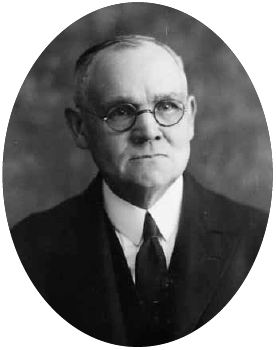
I like this quote from President Lorenzo Snow (back in 1900): |
| Lorenzo Snow |
Seventy years ago this Church was organized with six members. We commenced, so to speak, as an infant. We had our prejudices to combat. Our ignorance troubled us in regard to what the Lord intended to do and what He wanted us to do. We advanced to boyhood, and still we undoubtedly made some mistakes, which generally arise from a lack of experience. We understand very well, when we reflect back upon our own lives, that we did many foolish things when we were boys. Yet as we advanced, the experience of the past materially assisted us to avoid such mistakes as we had made in our boyhood.
It has been so with the Church. Our errors have generally arisen from a lack of comprehending what the Lord required of us to do. But now we are pretty well along to manhood. When we examine ourselves, however, we discover that we are still not doing exactly as we ought to do, notwithstanding all our experience. We discern that there are things which we fail to do that the Lord expects us to perform, some of which He requires us to do in our boyhood. While we congratulate ourselves in this direction, we certainly ought to feel that we have not yet arrived at perfection. There are many things for us to do yet.
Source: President Lorenzo Snow 6 April, 1900, CR
In Mormonism, revelation and church authority are not infallible. There's a saying I heard once that in Catholicism the Pope is infallible but nobody believes it and in Mormonism the prophet is fallible but nobody believes it.
Revelation in Mormonism is not a way for God to give immovable edicts. It is a process through which God inspires prophets called to lead His church. It moves from principle to principle, truth to truth, "until the perfect day" (D&C 50:24).
2. The pattern of revelation
Five months after the organization of the church that Lorenzo Snow was referring to, a crisis arose in the church. Hiram Page had claimed to have received revelations regarding how to build up Zion which several other church members had accepted as revelation from God (including Oliver Cowdery - the "Second Elder" of the church).Prior to a conference, Joseph Smith received this revelation which laid out the pattern of revelation the Lord wished to have in this dispensation (echoing patterns from other dispensations):
1 Behold, I say unto thee, Oliver, that it shall be given unto thee that thou shalt be heard by the church in all things whatsoever thou shalt teach them by the Comforter, concerning the revelations and commandments which I have given.
2 But, behold, verily, verily, I say unto thee, no one shall be appointed to receive commandments and revelations in this church excepting my servant Joseph Smith, Jun., for he receiveth them even as Moses.
3 And thou shalt be obedient unto the things which I shall give unto him, even as Aaron, to declare faithfully the commandments and the revelations, with power and authority unto the church.
4 And if thou art led at any time by the Comforter to speak or teach, or at all times by the way of commandment unto the church, thou mayest do it.
5 But thou shalt not write by way of commandment, but by wisdom;
6 And thou shalt not command him who is at thy head, and at the head of the church;
7 For I have given him the keys of the mysteries, and the revelations which are sealed, until I shall appoint unto them another in his stead.
D&C 28:1-7
Now, we can take this form of authoritarianism too far. But what the Lord clearly is calling for here is order in how His word is revealed and accepted institutionally in the church. It's a spectrum where we have authority squelching diversity and free expression on one end and on the other disorder and the conflict of interpretation against which Mormonism itself arose. Both are extremes which don't have a place in Mormonism. I think what we're seeing in light of these disciplinary actions is a navigation along that spectrum; and we need to understand the larger picture here.
My personal opinion is that what's at issue here isn't women ordination, gay rights/fellowship, or whether doubters are welcome. What's at issue is the Lord's established pattern of revelation and authority. Nearly 40 years ago, excommunication with regards to race and the priesthood occurred as close as several months before that policy change in 1978. Clearly those weren't about the issue itself which was already in the process of changing; they were about those who would steady the ark -- those who insist on a mode outside this established pattern. That's the issue being addressed here in my opinion. Not whether certain policies are "true" or whether the church is "with the times". I personally feel there can be a future for a greater & more full role for women, greater fellowship for gays, and more understanding for doubters. But I want any required institutional policy change or additional doctrine related to this to come from the Lord, not from those who mistake activism for the priesthood of God.
And when the direction that has come is, "No." or "Not now." We need to trust in modern revelation and not steady the ark.
3. We are entitled to personal revelation, but under "strict command"
To balance this out, we need to understand that in Mormonism we are promised the ability to receive personal revelation with regards to the mysteries of God (even beyond the words revealed by prophets). This is a huge part of my faith & testimony in the restored gospel. I won't be part of a faith that does not allow one to form their own opinions by faith and study. But that does not mean we have a free-for-all bazaar of confusion and contention. The Lord has called for a "house of order" (D&C 132:8). Remember, an environment of confusion and contention is exactly against which the restoration emerged.This is explained in Alma 12:9-11 when the prophet Alma was contending with Zeezrom:
9 And now Alma began to expound these things unto him, saying: It is given unto many to know the mysteries of God; nevertheless they are laid under a strict command that they shall not impart only according to the portion of his word which he doth grant unto the children of men, according to the heed and diligence which they give unto him.
10 And therefore, he that will harden his heart, the same receiveth the lesser portion of the word; and he that will not harden his heart, to him is given the greater portion of the word, until it is given unto him to know the mysteries of God until he know them in full.
11 And they that will harden their hearts, to them is given the lesser portion of the word until they know nothing concerning his mysteries; and then they are taken captive by the devil, and led by his will down to destruction. Now this is what is meant by the chains of hell.
God wants us to learn the mysteries of the kingdom and form our own opinions, but God is not an anarchist. He, an eternal Being who has seen countless worlds come and go, sees the need for order. So we should go learn all we can "by study and also by faith". But when we feel the need to command or impel others because of something we feel strongly about beyond the revealed word, then we are breaking the "strict command" by which we received that knowledge in the first place and step into the realm of unrighteous dominion and apostasy.
A key here in navigating this dynamic in the household of faith is that if someone comes to you insisting church members hold an opinion that can't firmly be grounded in the words revealed by prophets who have the "keys of the mysteries" for the church then you can know either 1) they are breaking that "strict command" from Alma 12:9 and/or 2) they are seeking to "command him who is at [the] head" -- independent of the veracity of their statement. It's a balance. Freedom on one hand, responsibility on the other.
The language in one of letters sent to the NY Times from the activists which they received from the LDS church seems to align with this doctrinal/policy approach:
The letter said, “you are not required to change your thinking or the questions you may have in your own mind,” but that she must keep her questions private and resolve them by talking to her bishop.
This is a exhortation to adhere to this pattern of revelation. The chastisement isn't for having an opinion. It's for promoting that opinion outside the Lord's pattern of revelation.
4. We need to have empathy towards the Lord's anointed
If find it very telling of God's desires for us that he places us in this situation where we each have our own passions/opinions/insights/knowledge/testimony but must come together in unity in order to grow. Surely he didn't do so that we would fight it out and resolve matters through protest, activism, or PR campaigns. Instead He requires faith, hope, forgiveness/repentance, and charity. Only through those can a true diversity of opinion, doctrine, and faith be maintained with (rather than against) living prophets.
 |
| Mormonism promotes a diversity of opinions balanced with unity in faith. |
I think much of this can be expressed in the dynamics of kites. Interestingly, kites work because of
opposing forces: lift and an anchor line. The wings, streamers, dowels, and wind provide the lift. But without the line to the ground that anchors it, the kite will quickly spiral down to the ground.
In the pattern of revelation above, Mormonism provides both sets of tools (lift and anchoring). We just have to understand and use both in the right balance. We get our lift through personal revelation and study, but that lift must be balanced and cannot overrun the anchoring to the ground found in prophetic revelation. The two dynamics work together to produce the desired effect and joy of the kite's flying.
Placing myself in the shoes of living prophets for a moment I realize that they have a sacred responsibility to provide these lines and anchors and are held accountable to God for how they fulfill that responsibility. Different individuals will have different lift and security to the lines based on their own personal relationship with God, what winds they fly in, and how they've built their own kite. But when individuals come along and insist that the lift they attained must be given to all they risk many of the other kites.
Given that the living prophets are the ones in charge of the lines, if they do not feel inspired through revelation to change the lines, one option for someone seeking that other kites lift the way they are is to have the other kites fly in their stronger winds. But when that is done it places more strain on the line which the kites are secured to. This will happen from time to time and can be healthy. We all have our faith and testimonies tried and our lines can be strengthened by it. But what are those in charge of the lines and the safety of the kites to do when the winds begin to threaten the security of the lines to other kites? At a certain point, a decision to preserve the security of the lines must be made over other dynamics or individuals.
So when I see church institutional policies which give me pause or that might be labeled "behind the times", I choose to put myself in the shoes of God's prophets and it seems clear that they are worried about loosing the footing and anchor that's needed for members to soar in the unity of faith. It's up to us (as individuals) to soar -- that's our right, but we cannot endanger the lines and anchors of others in doing so. An understanding and application of this balance is part of the essence of practicing Mormonism.
Tying the metaphor back to the recent events, these disciplinary actions towards activists, I think, are about how those in the priesthood have a responsibility for the safety of all kites (not just a select few) and see individuals & trends which are trying to force lift on others which are straining and even severing the lines which anchor people to the gospel of Christ. Their responsibility is to ensure those lines and anchors (they are accountable to that). So at a certain point they are called to halt things that threaten the lines or anchors of others.
5. Guiding Principles
For me, daily personal practice of Mormonism boils down to these things:- Covenants: These are the "commands" which we have received that anchor me to Christ. I stand by my covenants as my iron rod. These are my stronghold that I will not let go of and which I keep free of the "fluff" others would seek to attach to it. With covenants comes great strength.
- Learning: We, as Latter-day Saints, should be voracious learners. Especially in the miraculous age we live in where nearly all of mankind's information is literally at our fingertips. This will include individual 'mysteries' being revealed about God (through study/faith) and as well as the world around us through the miracles of science (through study/reason). We should discuss these, weigh them, refine them, and expound on them. But we cannot forget God's Kingdom and think that knowledge alone supplants the authority of God.
- Patience: I have to step back and realize that God has a plan for how/why He reveals mysteries to the church as a whole vs. how I feel He might reveal things to me. And to be patient both with the prophet when I feel differently about something but to also be patient with myself retaining humility in my opinions and beliefs always open to more information and God's revealed word.
There's a warning from the Book of Mormon that also touches on this dynamic. It contains an exhortation to gain personal knowledge and wisdom but also couples it with a warning to not let that draw one away from God and His counsels:
28 O that cunning plan of the evil one! O the vainness, and the frailties, and the foolishness of men! When they are learned they think they are wise, and they hearken not unto the counsel of God, for they set it aside, supposing they know of themselves, wherefore, their wisdom is foolishness and it profiteth them not. And they shall perish.
29 But to be learned is good if they hearken unto the counsels of God.
2 Nephi 9:28-29